 The Entire Point

On the afternoon of November 2, 2017, Justin Mills sat on a couch in the Wine and Wi-Fi Lounge of the Golden Nugget casino in Atlantic City, laptop open, doing what the room was built for. Now and then he talked to his friends nearby. Two detectives from the New Jersey State Police had come to watch him do it.
Later, under oath, the lead detective was asked whether he had seen anyone in the lounge do anything overtly illegal. “They were on the phone,” he said.
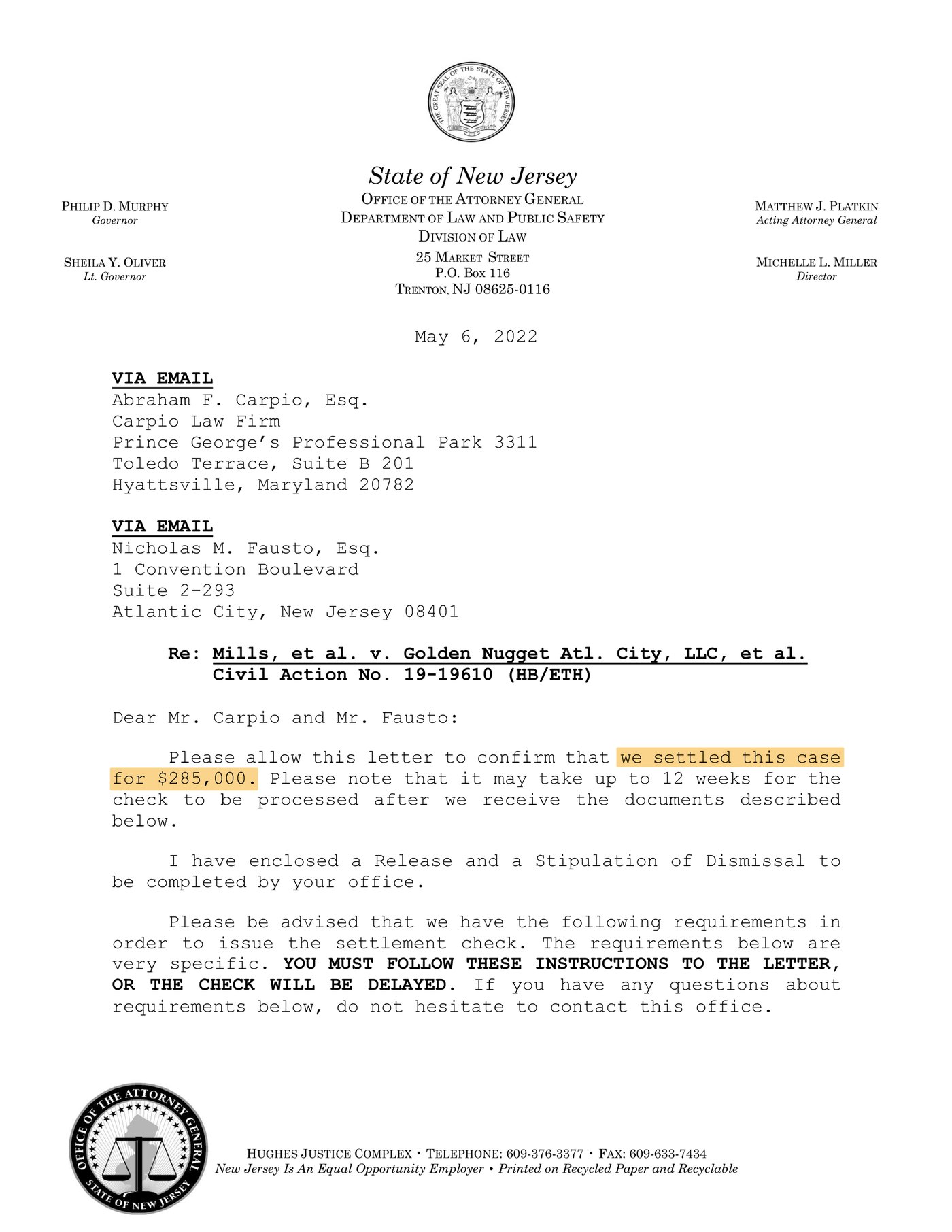
Before the day was out, Mills had been handcuffed, searched and fingerprinted. A federal judge later ruled the arrest unlawful. In 2022 the State of New Jersey settled the lawsuit for $285,000.
Justin Mills was a skilled player, and casinos do not always appreciate skill. In February 2014 he was playing blackjack at Maryland Live!, outside Baltimore, and counting cards. Counting cards is legal, as a federal judge would later put it, “when done through one’s mental acuity alone,” but the casino detained him anyway, and Mills filed a lawsuit. In July 2017 that judge, Richard D. Bennett, ruled that the casino “did not have any legal justification” for detaining him and entered judgment against it for false imprisonment without waiting for a jury. He also denied immunity to two county police officers who had been moonlighting at the casino. A trial on the remaining claims was set for September 5, but the case settled before it began, on confidential terms believed to be very favorable to Mills.
That November, Mills went to Atlantic City on vacation with a group of friends.
Detective Sergeant Richard Wheeler worked in the State Police’s Casino Gaming Bureau, where he saw a lot of DICE reports, the notices that casinos send to the State Police. He did not follow up on every one, but on November 2 he followed up on one from the Golden Nugget.
The surveillance manager who filed the report never spoke to the police about it afterward. The casino’s compliance manager did talk to Wheeler by phone, and she later testified that she told him the casino had “an unusual situation” and never asked him to come. “It’s not my job to tell the police what to do,” she said. The police, she explained, “act on their own.”
Wheeler went to the casino that afternoon with his supervisor, Detective Sergeant Carl Smallwood. They found Mills on the couch with his computer, and Wheeler called for backup. Four more officers arrived, including the head of the Intelligence Management Unit and officers from the Special Investigations and Strategic Investigations units. Two of them watched Mills for fifteen or twenty minutes while he used his phone, though they could not hear what he was saying.
When Mills’s friends left for the parking garage, two of the detectives followed and stopped them at their car. One of the friends, Daniel Chun, later testified that he was “slammed from behind against the car door” and put on the ground in handcuffs without any explanation. Chun told Wheeler that he had come to make money from the casino. That was the last thing Wheeler learned before he got on the phone and ordered Mills arrested. No one at the casino had asked him to.
Two officers walked into the lounge, identified themselves and led Mills out. He was handcuffed, searched, driven to the station, fingerprinted and questioned, and he spent a few hours in a holding cell with one arm cuffed to a metal bench. The police kept his laptop and his phone for seven months.
In October 2019, Justin Mills and Daniel Chun filed a lawsuit in federal court in Camden against the casino and five members of the State Police, at first representing themselves. The case was assigned to Judge Harvey Bartle III, who has been a federal judge in Philadelphia since 1991 and was previously Pennsylvania’s attorney general.
Bartle wrote three opinions in the case. The first came in June 2020, after the detectives asked to have the case against them dismissed under qualified immunity, the doctrine that protects every officer except, in the Supreme Court’s words, “the plainly incompetent or those who knowingly violate the law.” “The information possessed by the officers at the time of plaintiffs’ arrest,” Bartle wrote, “was that … Mills and Chun had walked within the casino, and that Mills had used a laptop and a cell phone in the Wine and WiFi Lounge of the casino.” “No reasonable officer,” he continued, “could have understood these facts and circumstances to constitute probable cause” for any crime under New Jersey law.
The second opinion came in August 2021, after everyone had testified under oath, and ran to sixty-four pages. Bartle wrote that there was “nothing even suspicious” about Mills “sitting in the lounge operating his computer and talking to Chun.” Nor was he impressed that Chun had told Wheeler in the garage that he had come to make money.
“Most who come through a casino’s doors hope to make money, however unlucky they may end up being.”
Judge Harvey Bartle III ·
Bartle then turned to Wheeler’s own experience. Wheeler, he wrote, was “an experienced officer who has investigated crimes in the gaming industry since 2006.” For an officer with that much experience, the judge held, it was unreasonable to conclude that Mills was doing anything illegal “because he was using his computer in the Wi-Fi Lounge — indeed the entire point of a Wi-Fi lounge — and was talking to Chun and others nearby.” Smallwood, his supervisor, testified that Wheeler would not have arrested anyone without his consent, and that they based the decision on what the casino had reported and on watching Mills at his computer “doing something.” Bartle held that this was not enough.

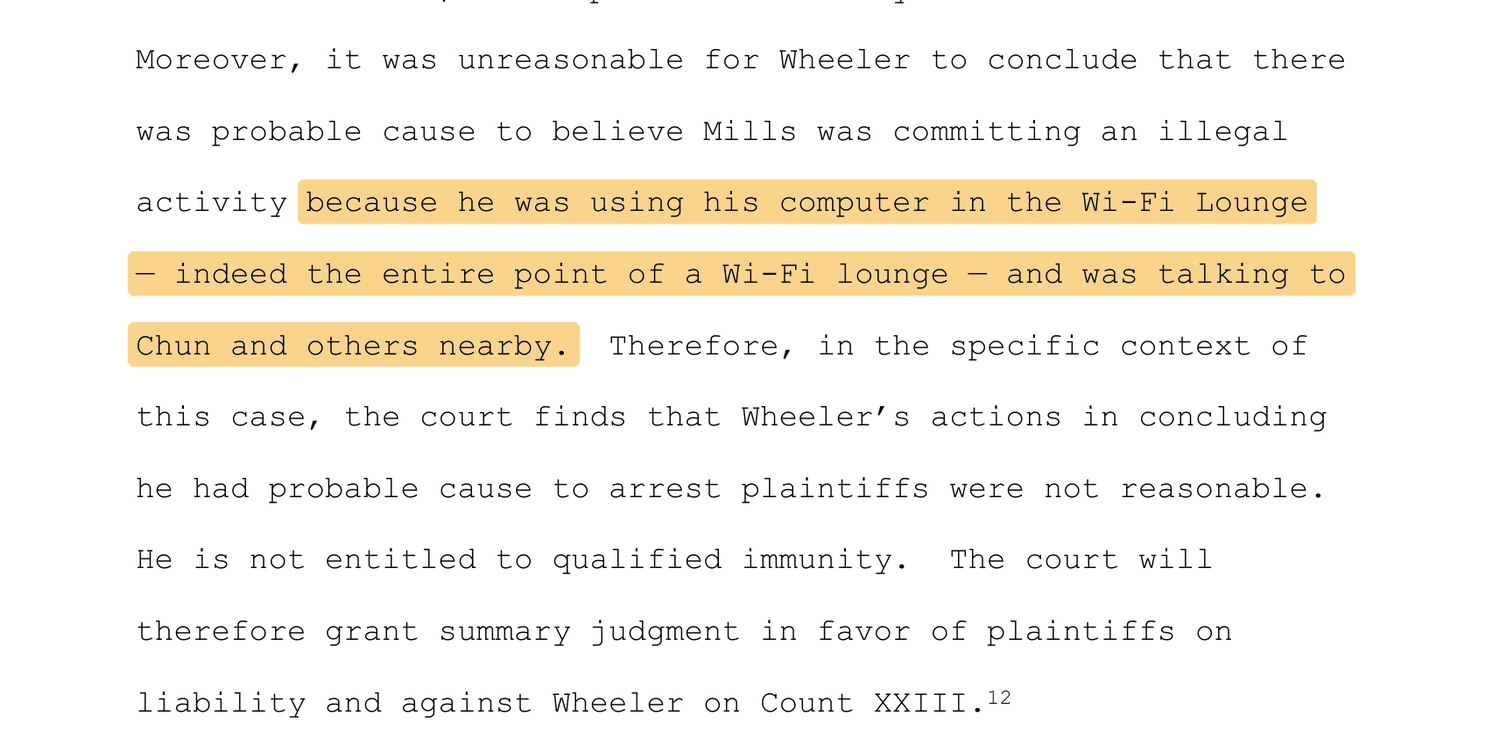
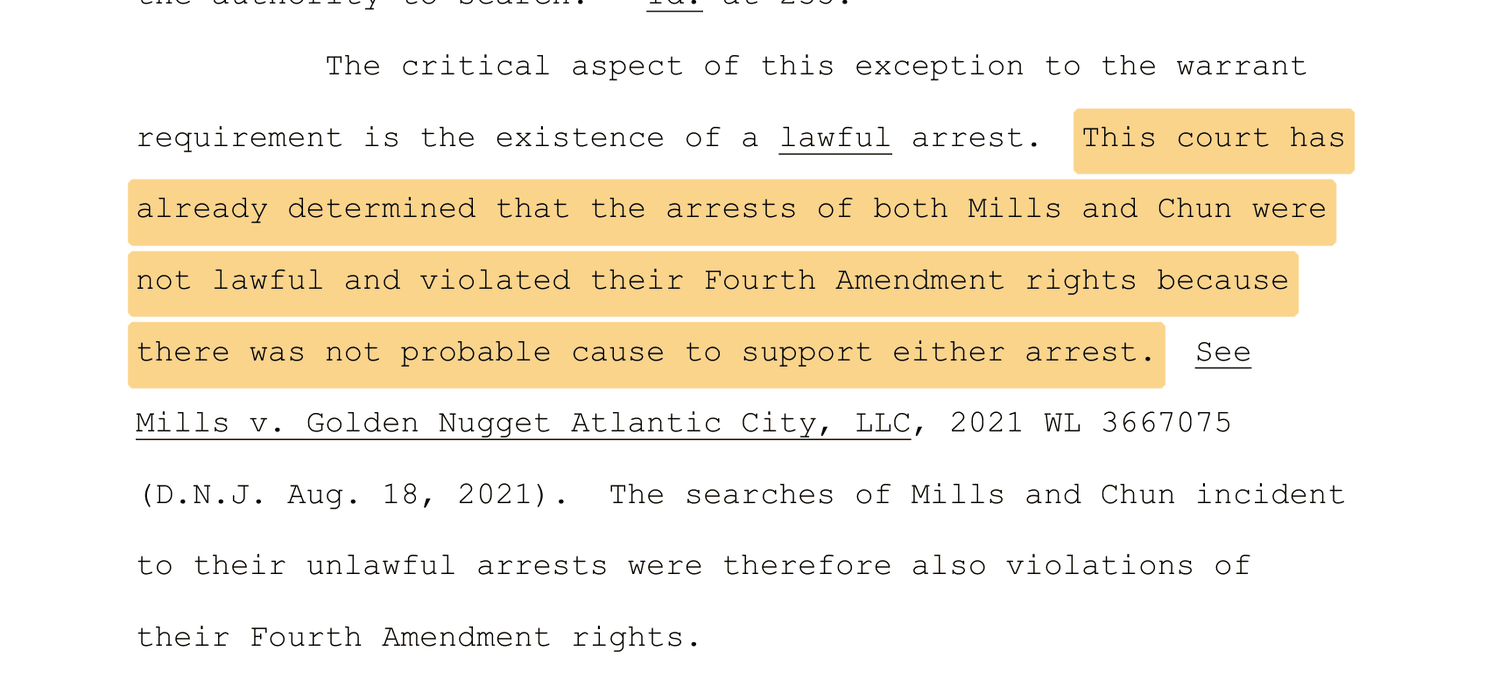
Bartle did not leave the question to a jury. He ruled that both arrests had violated the Fourth Amendment and entered judgment on liability, under federal civil rights law and under the New Jersey Civil Rights Act, against Wheeler, Smallwood and a third detective, Lance Moorhouse, holding that none of them was entitled to immunity. That December he ruled that the searches after the arrests were unlawful as well, since a search that depends on an arrest can be no more lawful than the arrest itself.
What remained was for a jury to decide the damages, but the State settled first. On May 6, 2022, the New Jersey Attorney General’s office sent a letter that began, “Please allow this letter to confirm that we settled this case for $285,000.” The next sentence said the check could take up to twelve weeks. The settlement ended the lawsuit, and the case was closed that July.
By the time the lawsuit ended, the Golden Nugget had closed the Wine and Wi-Fi Lounge for good.